 InQ.IFBA Portal da Inovação & Qualidade

By Beatriz Lourenço
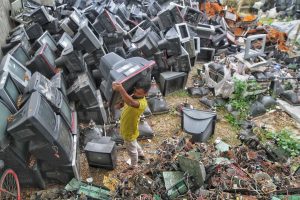
Have you ever heard about Waste of Electrical and Electronic Equipment (REEE)? Normally called as electronic waste, they are defined by the electrical directive as “equipaments whose the proper functioning depends of electric current or electromagnetic fields, as well as how equipaments for generating, transferring and measuring these currents and fields. It means that, in practice, the REEE are, basically, cellphones, computers, batteries and any kind of home appliances that can be found in a house, for example, water purifiers, microwave ovens, hair dryers and blenders. When those equipments are discarded in an incorrect way, being thrown into landfills or into the sea, they can cause serious damage to the environment.
In 2018, the Mineral Technology Center Cetem accomplished a survey that shows that 85% of the interviewed people kept some kind of device without functionality at home, among them headphones, old cell phones and parts of charges.
Nowadays, Brazil has the work of the Brazilian Association for Recycling of Electronics and Appliances (Abree) which aims to:
- “Define and manage the reverse logistics of post-consumer electronics and home appliances in Brazil, ensuring the proper final destination. It is responsible for contracting, supervising and auditing services provided by third parties, for the implementation of collective reverse logistics systems”;
- “To make efficient information generated by the reverse logistics system shared by all performers in the ecosystem, seeking to reduce operational/logistic costs and obtain economies of scale.”
- “Provide information about operations and costs, in addition to proposing innovative, efficient and effective solutions, seeking best practices for compliance with the PNRS – National Policy on Solid Waste.”

It is known that the undue disposal of electronic waste harms and even makes it impossible to recycle materials, causing damage to the environment. For this reason, for decades, laws, decrees and other legislative measures have been created that seek to determine and apply measures that are, safer when dealing with WEEE. The following measures are highlighted here:
● Law 12,305/2010: Also known as the ‘National Solid Waste Policy’ (PNRS), which provides for the reduction of waste generation and determines the destination of the material. This is one of the most important environmental laws in Brazil, and its objective is to disseminate conscious and sustainable consumption, applying concepts of recycling and reuse of materials.
● Decree No. 10.240, of February 12, 2020: Implies in its Art. 1 that “This Decree establishes norms for the implementation of mandatory reverse logistics system for electrical and electronic products for domestic use and their components…”. As presented in the decree itself, it regulates the reverse logistics system in our country, establishing a percentage of municipalities with reverse logistics and equipment that must be collected. This practice is also known as ‘Greenelectron’.
In addition to the above, non-legislative institutions also seek to find ways to restrict the use and disposal of electronic materials. IBAMA, created by Law 7,735 of February 22th, 1989, for example, created the Brazilian Solid Waste List in 2012, based on Commission Decision 2000/535/EC, and standardizes the language used in Brazil to declare disposable materials, standardizing All country. From now on, it is easier to obtain statistics and comparative data regarding the destination of solid waste.
Do you like the content? Não deixe de ler as our unpublished weekly materials, which, with certainty, will help him in various aspects. Visit also o nosso Instagram @inqportal e se quiser nos enviar alguma sugestão, esse é o nosso e-mail: inq.vdc@ifba.edu.br


