 InQ.IFBA Portal da Inovação & Qualidade

by Natan Oliveira
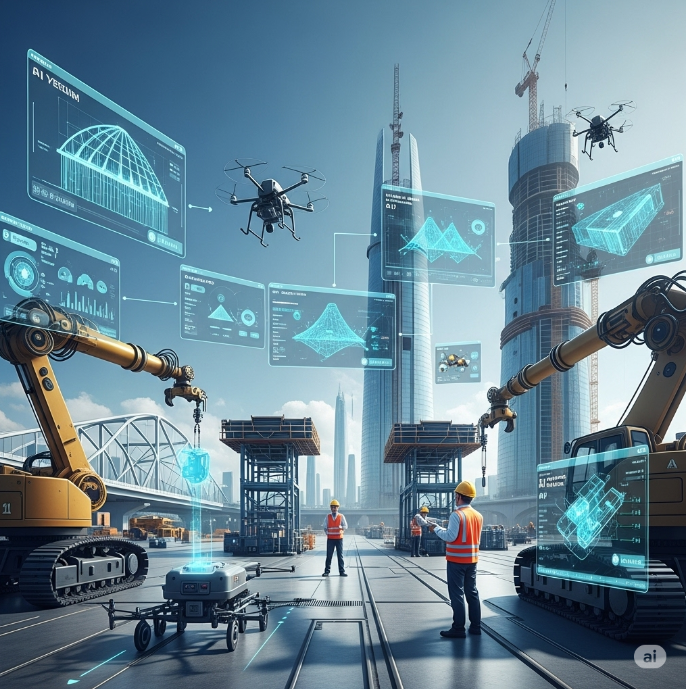
Source: AI-generated
The revolution of Artificial Intelligence (AI) in Civil Engineering and Construction, integrated with Building Information Modeling (BIM), is no longer a distant promise, but, a reality that redefines processes, raises quality standards, and imposes ethical challenges. Over the past decades, digitalization has already transformed how we conceive and manage construction projects. Today, AI expands this transformation by enhancing data analysis, generative design, and automation — all under the guidance of standards such as ISO 19650, which is essential for information management in BIM projects.

Source: Ampla Divisórias
In structural design, machine learning algorithms process vast sets of variables — soil conditions, material properties, performance requirements — to propose solutions that maximize efficiency and minimize waste. The combination of parametric modeling, finite elements, and clustering techniques (like k-means) with nonlinear regression has been shown to drastically reduce pre-sizing time without compromising safety. When coupled with BIM, these algorithms access reliable and dynamically updated data, improving simulation accuracy and enabling 3D visualization of results.
Even more daring, AI-driven generative design automatically explores multiple architectural and structural configurations based on defined parameters, opening doors to unprecedented shapes and sustainable solutions. Studies incorporating evolutionary algorithms into BIM platforms already show significant improvements in performance and material usage, anticipating a future where optimal geometries emerge without direct human intervention.
On construction sites, AI integrated with BIM enhances project management: from real-time progress tracking to intelligent resource allocation and cost forecasting based on historical data and market variations. These decision-support systems reduce the risks of delays and budget overruns, giving managers a holistic and proactive view of the project.
However, this transition requires an ethical and responsible approach. Bias in datasets can compromise structural safety; the increasing autonomy of AI raises concerns about accountability in case of failures; and the extensive data collection within BIM environments demands rigorous privacy and security safeguards. It is essential for professionals to stay in control, understanding and validating algorithmic decisions to ensure transparency and fairness in decision-making.
Finally, the widespread adoption of AI combined with BIM is reshaping the profile of the civil engineer: less focused on repetitive tasks and more engaged in interpreting complex data, setting ethical guidelines, and developing creative solutions. The real power of this revolution lies in the symbiotic collaboration between engineer and machine, where each brings its strengths — human intuition and critical judgment, and AI’s computational power and analytical speed. Only through this partnership can we build truly intelligent, safe, and sustainable infrastructure.
Did you enjoy the content? Look for more information in “A Inteligência Artificial na Engenharia Civil” published in Coleção Pesquisas em Temas de Engenharias – Vol. 9, by Aniel de Melo Dias, Liliane Cruz Gomes de Souza Santos, and Hélio Augusto Goulart Diniz. Don’t miss our exclusive weekly articles, which will surely help you in many ways. Also visit our Instagram @inqportal, and if you’d like to send us a suggestion, here’s our email: inq.vdc@ifba.edu.br.